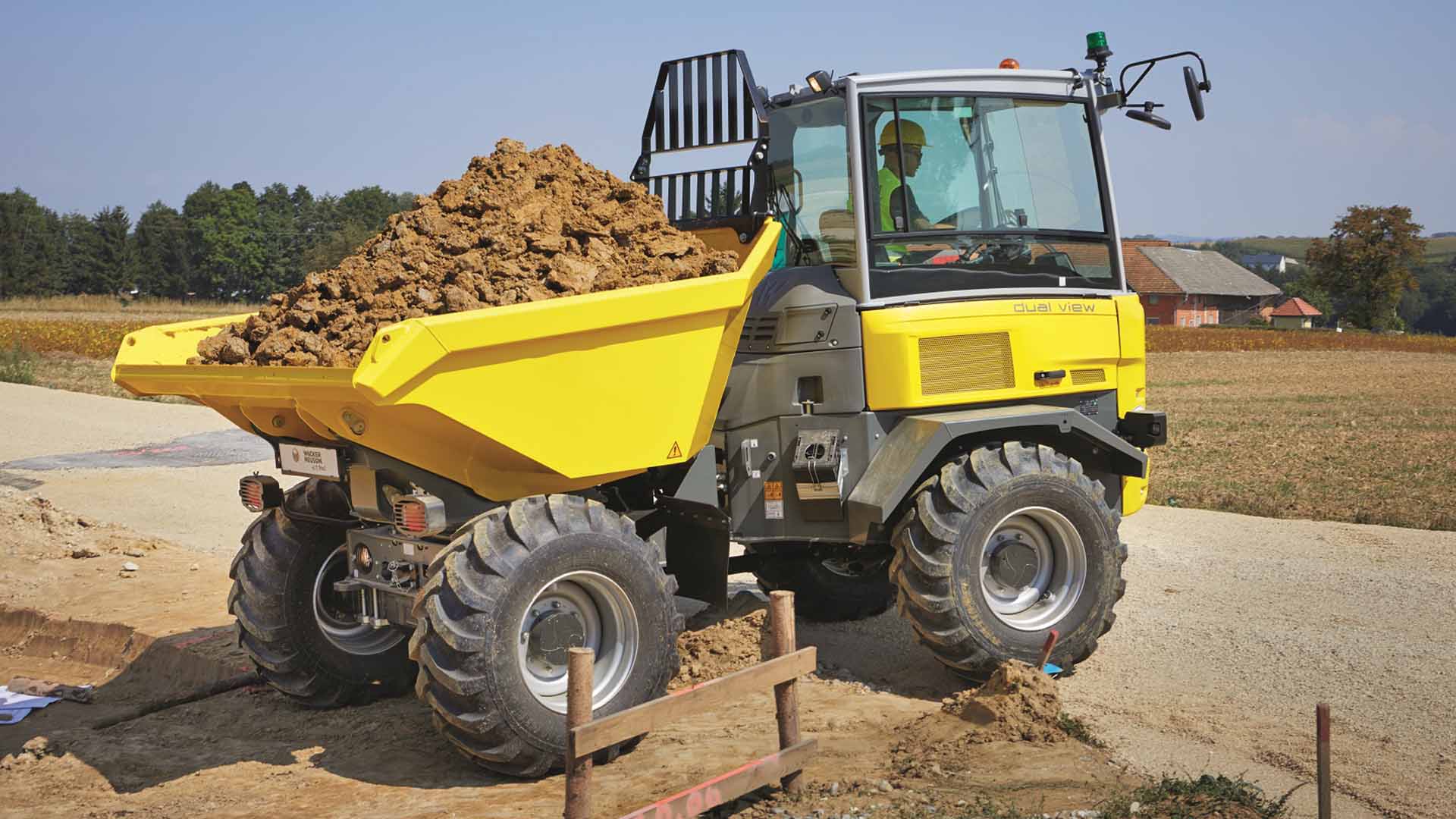
6T vs 9T Site Dumpers: Which Payload Do You Need?
Choosing between a 6T vs 9T site dumper means matching capacity to the work. The material being moved, the loading equipment, access and haul distance all influence which machine will suit your project.
At Conplant, our site dumper hire range includes 6 tonne and 9 tonne Wacker Neuson models, with ROPS (rollover protective structure) versions and a closed-cabin DV90. When helping you compare them, we look at the loading point, the route and the unloading area together. For an overview of where dumpers fit on site, see the benefits of a site dumper for construction projects.
Table of Contents:
Quick answer: choose for the full haul cycle
6T vs 9T site dumper specifications
Start with the material you need to move
Check access from loading point to tipping area
Assess the route for a loaded machine
Match the dumper to your loading equipment
Compare the complete haul cycle
Choose a configuration that suits the work
Quick answer: choose for the full haul cycle
Payload is one of several linked decisions. A 6 tonne dumper may suit tighter access, smaller loading increments or sites where manoeuvrability is the priority. A 9 tonne dumper may suit higher-volume cycles where access, ground conditions, loading plant and site controls support the larger machine. Either way, check site conditions and the exact model before booking.
6T vs 9T site dumper specifications
Our hire fleet includes the Wacker Neuson DW60, DW90 and Dual View DV90. Their listed specifications provide a starting point for comparing capacity and access requirements.
Specification | DW60 ROPS | DW90 ROPS | DV90 ROPS | DV90 closed cabin |
Rated payload | 6,000 kg | 9,000 kg | 9,000 kg | 9,000 kg |
Heaped skip capacity | 3,200 L | 4,400 L | 4,350 L | 4,350 L |
Listed weight | 4,866 kg | 5,746 kg | 4,295 kg | 5,250 kg |
Overall width | 2,250 mm | 2,463 mm | 2,420 mm | 2,420 mm |
Overall height | 3,110 mm | 3,355 mm | 2,945 mm | 3,382 mm |
Overall length | 4,935 mm | 5,185 mm | 4,891 mm | 4,891 mm |
Specifications vary by model, skip, cabin or ROPS and configuration. Confirm the specifications of the allocated hire unit with our team before booking.
The DW60 has the narrowest listed width. However, the DV90 is slightly shorter than the DW60, and the DV90 ROPS has a lower listed height. That’s why access should be assessed against the exact model rather than the payload class alone.
Start with the material you need to move
Site dumper payload is the maximum rated mass of material the machine can carry. Skip capacity is the volume it can hold, usually measured in litres.
A 9 tonne dumper offers 50 per cent more rated payload than a 6 tonne dumper. The difference in skip volume is smaller: our listed 9 tonne skips hold approximately 36 to 38 per cent more than the DW60’s 3,200 L skip.
How much of that capacity you can use depends on the material’s type and density. Dense material may reach the payload limit before the skip is full. Lighter material may fill the skip while remaining below the rated payload.
Moisture and changes in material composition can also affect load mass. Don’t assume a heaped load weighs the same from one load to the next, even with the same material.
When discussing hire with our team, tell us what you are moving and the estimated quantity. Every load needs to stay within the machine’s rated limits and operating instructions.
Check access from loading point to tipping area
A restricted entrance may favour the narrower DW60, but the machine still needs enough room to work once it is through the gate.
Assess the entire route, including corners, passing areas and overhead obstructions, as well as the space around the loading plant and any other machinery operating there. The overall dimensions are a starting point; safe operating clearance and turning requirements also need to be allowed for.
At the unloading area, consider how the dumper will approach, position and discharge its load. There needs to be a suitable area with level, stable ground for tipping, and access to where the material is required.
Delivery access is part of the same discussion. The transport vehicle needs a suitable approach and a level unloading area. Share any restrictions with our team when arranging equipment transport so they can be considered before delivery day.
Assess the route for a loaded machine
The haul route needs to support the dumper carrying its intended load. The listed weights in the table exclude the material being carried, so they should not be treated as loaded machine weights.
Ground moisture, bearing capacity, soft areas, trench edges, overhead services and embankments all need consideration. Gradients and cross-slopes must be assessed against the operating limits of the selected machine, including any different requirements for travelling and tipping.
Conditions can change during the hire. Rain, ground movement, repeated traffic or nearby excavation may affect a route that was suitable at the start of the project.
Match the dumper to your loading equipment
The excavator or loader needs to fill the dumper without exceeding its rated payload. Estimate the mass delivered in each bucket using the material’s bulk density (its mass per cubic metre as loaded) and the expected bucket fill. This helps establish the number of loading passes each dumper needs. Bucket volume alone does not tell you how much a load weighs.
The loading arrangement also needs suitable reach, clearance and positioning. A machine with adequate bucket capacity may still be restricted by the width and height available around the loading point.
A 9 tonne dumper may need more loading passes, but the larger load can reduce the total number of trips. That may be worthwhile where travel takes up a substantial part of the cycle.
If the loading plant cannot supply material quickly enough, the larger dumper may spend more time waiting. A 6 tonne machine may meet the required output with a more balanced loading and travel cycle.
Compare the complete haul cycle
Payload is only one factor in hourly production. Each cycle includes loading, travelling, waiting, tipping and returning.
On a longer haul, carrying more material per trip may reduce repeated journeys. On a short route, loading time and delays at the tipping point may have a greater influence. Traffic controls, pedestrian crossings and shared access can also affect cycle times. If the dumper regularly waits for another machine to clear the unloading area, extra skip capacity will not resolve that delay.
Compare the load each machine can safely carry with the number of realistic cycles it can complete, allowing for queues and site controls. This shows whether additional payload will improve production, or whether loading, site conditions, the route or the tipping area is setting the pace.
Choose a configuration that suits the work
Our DW60 and DW90 listings include swivel tipping through 180 degrees. The DV90’s Dual View system allows the operator’s console to rotate through 180 degrees to face the direction of travel.
These features influence different parts of the job. Swivel tipping affects where material can be discharged. Dual View affects the operator’s position during travel and direction changes.
Consider visibility along the route between the loading and tipping points, then confirm the skip configuration, cabin or ROPS, cameras, alarms and any project-required safety systems for the allocated unit.
Which payload suits your project?
For a short haul through a restricted entrance, the DW60’s narrower width may be the deciding factor. If its payload and cycle time can meet the planned output, additional capacity may offer limited benefit.
On an open site with a longer haul, a 9 tonne dumper may reduce the number of journeys required. That advantage depends on the loading plant supplying enough material, and on the route and tipping area accommodating the loaded machine.
These are starting points. Our team can help compare available hire options using your material, estimated volume, loading plant, haul distance, gradients, access dimensions and project timing. Request a quote for site dumper hire to discuss a machine suited to your next project.
Frequently asked questions
What is the payload difference between a 6 tonne and 9 tonne site dumper?
A 9 tonne dumper has 3,000 kg more rated payload, a 50 per cent increase. This does not automatically translate into 50 per cent more production.
How much larger is a 9 tonne dumper's skip?
Our listed 9 tonne skips hold approximately 36 to 38 per cent more volume than the DW60’s skip. Usable capacity depends on the material and the rated payload.
Which dimensions should I check before hiring?
Check entrances, overhead clearance, turning space, and loading and tipping areas. Allow for safe operating clearance and assess delivery access separately.
How does material density affect dumper selection?
Denser material reaches the payload limit in a smaller volume, so a full skip is not a reliable measure of load mass.
How should a dumper be matched to loading equipment?
Estimate bucket payload and loading passes, then compare loading time with the travel, tipping and return stages of the cycle.
What operator training and competency should be checked?
Confirm training and competency for the selected machine, familiarity with its operating instructions, and the project’s induction and authorisation requirements.