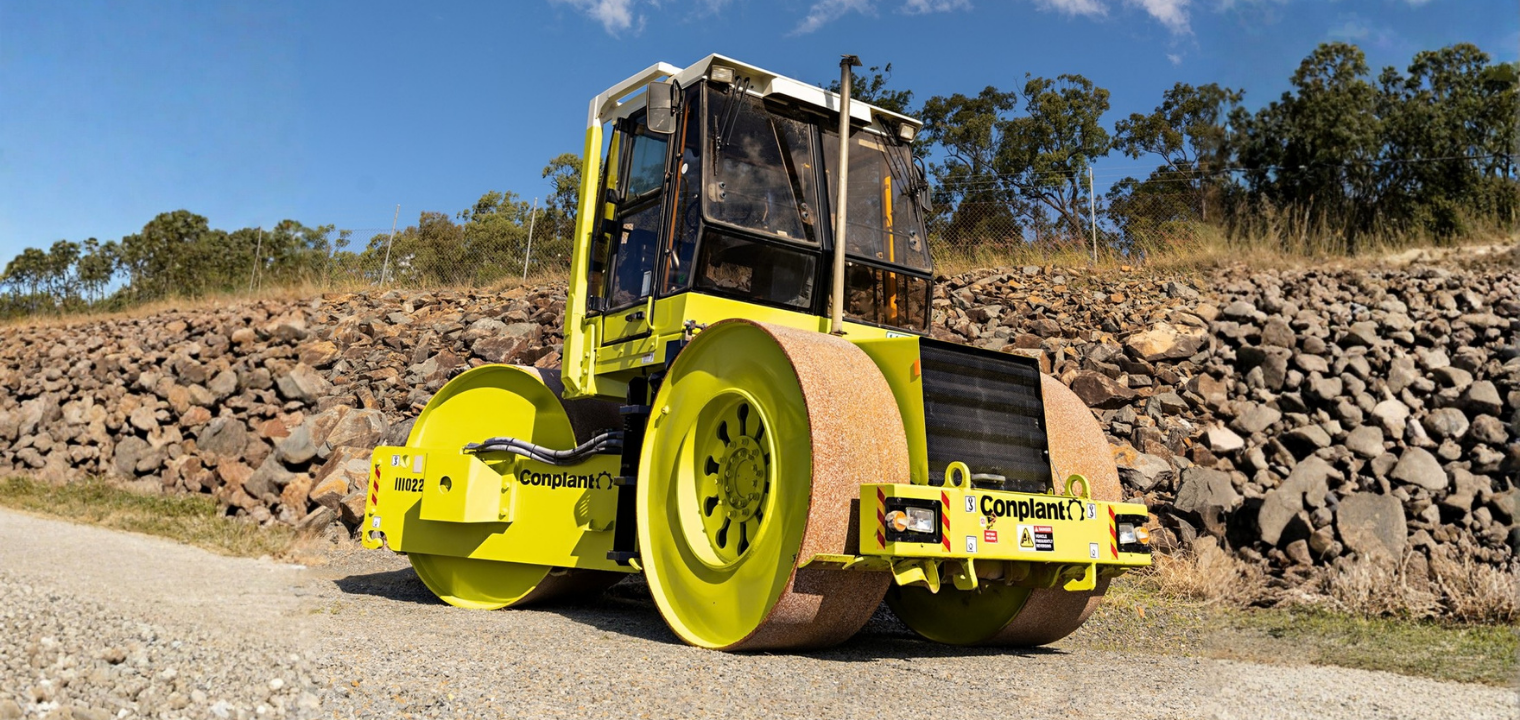
Proof rolling is used to assess how an earthworks or pavement layer responds when approved heavy plant travels across its surface. Rather than producing a single test result, it allows an authorised observer to look for visible movement (deflection), deformation or instability across the nominated area.
The Austroads ATM-440-25 Proof Rolling test method defines proof rolling as a process for assessing the strength, stiffness and uniformity of material by moving heavy plant over the surface and observing any resulting deflection or deformation. It may be undertaken on an earthworks layer or pavement layer.
On site, the exact requirements are controlled by the relevant project specification, approved procedure and quality plan. These documents determine where proof rolling is required, which plant can be used, how the area must be covered and what response is considered acceptable.
We supply compaction equipment for hire, including roller types that may be specified for proof rolling. The project’s engineers, geotechnical representatives or other authorised personnel remain responsible for establishing the procedure, nominating the required plant, observing the proof roll and determining whether the completed layer satisfies the relevant requirements.
Table of Contents:
Is proof rolling the same as compaction?
What equipment is used for proof rolling?
Where does Völkel Intelligent Compaction fit?
How does the proof rolling process work?
Warning signs that require investigation
What happens when an area does not pass?
What is proof rolling?
Proof rolling, sometimes called test rolling, is an observation-based field assessment. Approved plant applies a controlled load to the surface while a nominated observer watches how the layer responds.
It is commonly completed before the next pavement layer is placed or before the area progresses through a specified hold point. The purpose is to identify sections that may behave differently from the surrounding material and require further investigation.
A layer may appear generally sound yet contain isolated areas that yield or deform under load. By covering the nominated area using an approved rolling pattern, proof rolling can help identify this variability before it is covered by subsequent work.
Is proof rolling the same as compaction?
Compaction is the process of applying energy to material to reduce air voids, rearrange particles and improve its engineering properties. Proof rolling is an assessment undertaken after, or as part of reviewing, that work.
A roller used during proof rolling still applies load to the ground and may have some compactive effect. That does not change the purpose of the activity. During a proof roll, the focus is on observing how the layer behaves under a controlled load.
The Austroads Guide to Pavement Technology Part 8 describes proof rolling as an assessment of immediate stability rather than a direct measure of the degree of compaction. It also warns that dry material may appear stable under proof rolling even when its compaction level is below the required standard.
This distinction matters. A surface that shows no obvious movement may still need to satisfy separate moisture, density or other conformity requirements. Proof rolling provides another source of information within the broader quality assurance process. It does not prove every property of the layer.
VicRoads guidance takes a similar position, describing proof rolling as complementary to the assessment of compaction through field density testing.
What equipment is used for proof rolling?
Static three-point rollers, multi-tyre rollers and large smooth drum rollers operated in static mode are among the plant types that may be used where approved. Marco rollers and water trucks can also be used depending on the project and specification.
Static three-point rollers apply load through three steel drums without relying on vibration. Their drum arrangement provides overlapping coverage, while their operating mass applies a consistent static load to the surface. Our static three-point hire range includes machines predominantly used for proof rolling and the compaction of thin granular or semi-cohesive layers.
Multi-tyre rollers apply load through a series of rubber tyres. Depending on the machine, the operating weight may be adjusted using ballast. Tyre pressure, ballast, contact area and overall machine loading can all influence how the load is transferred into the surface.
Large smooth drum rollers, typically within the 15 to 20 tonne operating range, may also be approved for proof rolling bulk earthworks lots and embankments. When used for this purpose, the roller operates without vibration and applies its load statically through the drum. The required machine mass and operating conditions must still be established by the project specification or authorised project representative.
The fact that a machine is heavy or commonly used for proof rolling does not automatically make it suitable for a particular project. The plant type, operating mass, tyre pressure, load configuration and other operating requirements must be established by the project specification or authorised project representative. Once those requirements have been confirmed, we can check whether equipment meeting them is available within our compaction fleet.
Where does Völkel Intelligent Compaction fit?
Proof rolling and intelligent compaction serve different purposes. Völkel Intelligent Compaction supports the preceding compaction process by giving operators visibility of machine position, rolling patterns and pass counts.
On configured earthworks applications, GNSS and an accelerometer can also record ground-response information. This can support coverage records and help project teams review how compaction was completed before the layer moves to its specified testing or acceptance activities.
Völkel does not carry out or assess a proof roll, and it does not replace the authorised observer, project-specific acceptance criteria or other testing required under the specification. Völkel might highlight soft spots in a pavement or subgrade that could benefit from further geotechnical investigations.
Völkel has been used to validate 100% coverage for proof rolling along with pass to pass overlap on airport works as per project specifications.
How does the proof rolling process work?
A proof roll should follow the project specification and approved testing procedure. While the details differ between projects, the process will generally cover the following stages.
- Confirm the requirements
Before the machine starts, the project team should confirm the layer and area to be assessed, approved plant, required loading, rolling pattern, operating conditions and acceptance criteria.
The nominated observer must also be identified. Depending on the project, this may be a geotechnical representative, project engineer rather than superintendent I’d assume? , project verifier or another authorised person.
- Prepare the area
The layer needs to be ready for assessment under the applicable quality plan. This includes confirming safe access, clearly identifying the test area and checking whether moisture or surface conditions are within the required range.
Moisture is particularly important because it can change the way a layer responds. Material that is too dry may appear stable even if other compaction requirements have not been achieved. Excess moisture can contribute to movement, pumping or instability.
The assessment should not proceed simply because the roller is already on site. If conditions do not match the approved procedure, the result may not provide a reliable basis for accepting or rejecting the work.
- Cover the nominated area
The operator drives the approved plant over the layer using the required speed and rolling pattern. The pattern should provide the coverage specified for the project, including wheel or drum overlap where required.
It is not enough to make a few passes through the most accessible part of the area. For example, Transport for NSW D&C R44 Earthworks requires the prescribed proof rolling pattern to cover the full width and length of each applicable lot. This is one example of how an authority specification may define the required coverage. Other projects may set different requirements.
Völkel is designed to make it easier for an operator to adhere to a desired rolling pattern along with speed and other parameters. From an office and liability perspective, Völkel provides detailed records for quality reporting to prove that a specification was adhered to and achieved.
- Observe and record the response
As the machine travels across the surface, the approved observer looks for locations where the material responds differently from the surrounding area.
The location and type of response should be recorded accurately. Records may include the area assessed, plant used, loading configuration, date, surface conditions, rolling pattern, observations and any sections marked for investigation.
Is it better to put my paragraph above here?
- Complete the required release process
The results are reviewed against the applicable acceptance criteria. If the layer performs satisfactorily, it may progress through the relevant witness point, hold point or release process.
Warning signs that require investigation
The purpose of proof rolling is to observe the behaviour of the surface under load. Warning signs may include:
- Rutting: permanent wheel or drum impressions left in the surface.
- Yielding: material continuing to move or deflect under the applied load.
- Pumping: fine material, moisture or slurry moving upwards under pressure.
- Heaving: material rising or displacing beside the loaded area.
- Cracking: visible cracks forming or opening as the plant passes.
- Instability: movement that indicates the layer is not responding uniformly.
- Visible deformation: a noticeable change in the surface profile during or after loading.
Transport for NSW D&C R44, for example, states that proof-rolled surfaces must not exhibit visible deformation, rutting, yielding, distress or instability. These are requirements within that specification and should not be applied automatically to every project without checking the governing documents.
These warning signs can have several possible causes, including excess moisture, inconsistent material, inadequate compaction, variations in layer thickness or weak underlying material. They indicate where further investigation may be needed rather than providing a diagnosis.
What happens when an area does not pass?
When an unsatisfactory response is observed, the affected area should be marked and recorded so it can be assessed properly. Progression over that section may need to pause while the results are referred to the authorised geotechnical, design or project representative.
Further investigation may involve reviewing moisture and compaction records, undertaking additional field testing, inspecting the material or assessing the condition of underlying layers.
Standard static and multi-tyre proof rolling plant primarily stresses the upper 300 to 500 mm of the profile. A satisfactory proof roll therefore indicates stability within the zone influenced by the applied load, but does not verify the condition of deeper underlying strata.
Depending on the findings and approved advice, the response may involve moisture conditioning, additional reworking, removing and replacing unsuitable material, stabilisation or another designed ground-improvement treatment. Where deeper or more variable conditions are identified, the project’s geotechnical or design representative may consider a specialist method such as High Energy Impact Compaction. Delivered by specialist providers including Landpac Asia-Pacific, HEIC is a separate ground-improvement process and does not form part of proof rolling or Conplant’s equipment hire service. Landpac was used for proof rolling on RAAF Tindal to ensure there were no voids in the underlying sandstone or limestone. One or the other type of rock…
It is worth noting that the stiffness value measured with Völkel via the accelerometer, will measure to approximate 1m or so in depth on a normal vibratory roller. This provides more awareness of where soft locations might exist in the underlying subgrade rather than just the pavement layer you could be compacting. This can be used as a complementary tool to provide further insight to the geotechnical team for investigation as deemed necessary.
The appropriate response cannot be selected from the visible symptom alone. The treatment must address the confirmed cause and comply with the relevant design and project specification. Any repeat proof roll or other reassessment should then follow the approved process before the area is released.
Limitations and good practice
Proof rolling can provide useful coverage of an earthworks or pavement area, but its value depends on how consistently the process is completed.
Changes in plant loading, tyre pressure, operating speed, pass pattern, moisture condition or observation method can affect the response being assessed. Using different equipment or conditions across the same area can make the results harder to compare.
The assessment also relies on competent observation. Safe separation must be maintained between the moving plant and personnel, while allowing the authorised observer to see the surface response clearly. Communication between the operator and observer should be agreed before rolling begins, particularly where work must stop so an area can be marked or examined.
Above all, proof rolling should remain within its proper role. It is a practical way to assess immediate and visible layer response under load. It works alongside the project’s other testing and verification requirements rather than replacing them.
Compaction equipment hire from Conplant
Where a project specification or authorised representative has nominated the required roller type and operating requirements, we can check equipment availability across our national compaction hire fleet.
Our range includes static three-point rollers, multi-tyre rollers and other compaction equipment used across earthworks and pavement construction. We can also supply selected hire rollers with Völkel Intelligent Compaction where additional visibility of machine position, rolling patterns and pass counts is required. Völkel can also be sold/purchased and retrofitted to a contractor’s own rollers when required.
To check equipment availability, request a hire quote or call 1300 166 166.
Frequently Asked Questions
What is proof rolling?
Proof rolling is a field assessment in which approved heavy plant travels over an earthworks or pavement layer while an authorised observer checks for visible deflection, deformation or instability.
Is proof rolling the same as compaction?
No. Compaction applies energy to improve the material, while proof rolling assesses how the completed layer responds under a controlled load. The roller may have some compactive effect, but assessment is the primary purpose.
What equipment can be used for proof rolling?
Check the machine details, hire period, included operating hours, delivery, collection, fuel, cleaning, damage arrangements, breakdown support and the procedures for extensions and off hire.
What visible responses can indicate a problem?
Rutting, yielding, pumping, heaving, cracking, instability and other visible deformation may require investigation. Acceptance criteria are determined by the governing project documents.
Who should observe a proof roll?
The proof roll should be observed by the person authorised under the project specification or quality plan. This may be a geotechnical representative, project engineer, project verifier or another nominated person.
What happens when an area does not satisfy the proof rolling requirements?
The affected location is generally marked and recorded before being referred for further investigation. Any remediation and repeat assessment must follow the project specification and approved technical advice.