If you make a living using heavy equipment or running a fleet, you already know fuel burn is one of your highest operational costs. Every litre saved protects your margins and frees up budget for people, equipment and growth.
For construction, civil and government operations, road construction, learning how to reduce fleet operating fuel costs isn’t just a nice-to-have. It can be the difference between finishing a project profitably or slipping into the red.
At Conplant, we’ve refuelled thousands of rollers and supported projects across Australia for over six decades. We know exactly where fuel can be wasted on a job site, and more importantly, how to prevent potential fuel loss on your project
This guide goes beyond the basics. It’s not just a checklist. It’s a roadmap to help you understand where you’re losing efficiency and how to turn that around using smarter gear, better systems and well-trained people.
Contents:
Why Fuel Costs Are a Major Expense for Fleets
1. Train Operators for Smarter, Safer Fuel Usage
2. Use Technology to Remove Guesswork
3. Use Fuel Cards Strategically
4. Maintain Equipment for Fuel Efficiency
Why Fuel Costs Are a Major Expense for Fleets
Fuel doesn’t just burn through your tank; it burns through your bottom line. And with global price swings on a weekly basis and unpredictable supply chains, fuel costs can wreak havoc on:
- Project profitability
- Cash flow and working capital
- Tender pricing and competitiveness
But there’s good news. Unlike market forces, fuel efficiency is something you can control. In fact, small changes can lead to big wins across your business:
- Improve profit margins job by job
- Extend equipment life by reducing overuse and avoiding any potential machine damage
- Lower emissions and strengthen ESG credentials
- Win more tenders by demonstrating cost control and sustainability
1. Train Operators for Smarter, Safer Fuel Usage
The single biggest difference between a fuel-efficient shift and a wasteful one? The operator.
Real gains come from teaching fuel-smart behaviours:
- Use the correct vibration settings, don’t run at maximum revs when you don’t need to
- Match passes to lift thickness
- Avoid overcompensating with larger machines when not required
- Maintain smooth operational control and reduce harsh machine shutdowns
Machines idling for breaks or cab comfort are a massive silent cost. Encourage:
- Engine shutdowns during lunch and stand-downs
- Avoid excessive warm-up idling. Modern engines operating in Australian conditions typically do not require extended warm-up periods.
- Alternatives to idling for cabin temperature control
- Programming maximum idle times in machines’ ECUs when possible
Even trimming idle time by 10 minutes a day, per unit, adds up to thousands in yearly savings across a medium fleet.
Telematics gives you operator-level insight into fuel burn, idle time, engine shut-downs and braking behaviour. Use it to:
- Identify high-consumption shifts
- Flag any excessive idle time on site
- Target coaching by driver or machine
- Celebrate low-consumption success stories
- Identify underutilised machines across projects
- Improve fleet utilisation, potentially reducing the number of units required and lowering both capital and fuel costs
2. Use Technology to Remove Guesswork
Technology can reveal fuel waste that’s hiding in plain sight. From compaction inefficiencies to inconsistent operator techniques, the right tools make it possible to see exactly where energy, time and budget are being lost. What used to be guesswork is now visible and fixable, with the right data and system management.
That means smarter machines, integrated data platforms, and intuitive feedback tools, such as intelligent compaction systems, can help prevent costly over-compaction, reduce idle time, and inform better purchasing decisions. These systems don’t just give you data; they give you total control of your assets and project.
Combining data from fuel cards, service logs and machine telematics creates a clear view of:
- True litres per hour or km per machine and per job
- Spikes in Fuel consumption (signalling leaks or misuse) or possible theft
- Any excessive idle time
- Performance by machine model, crew or site
On job sites, excess passes don’t just waste fuel. They can lower base elevations, forcing you to import more material to meet spec. That’s a cost no one budgets for.
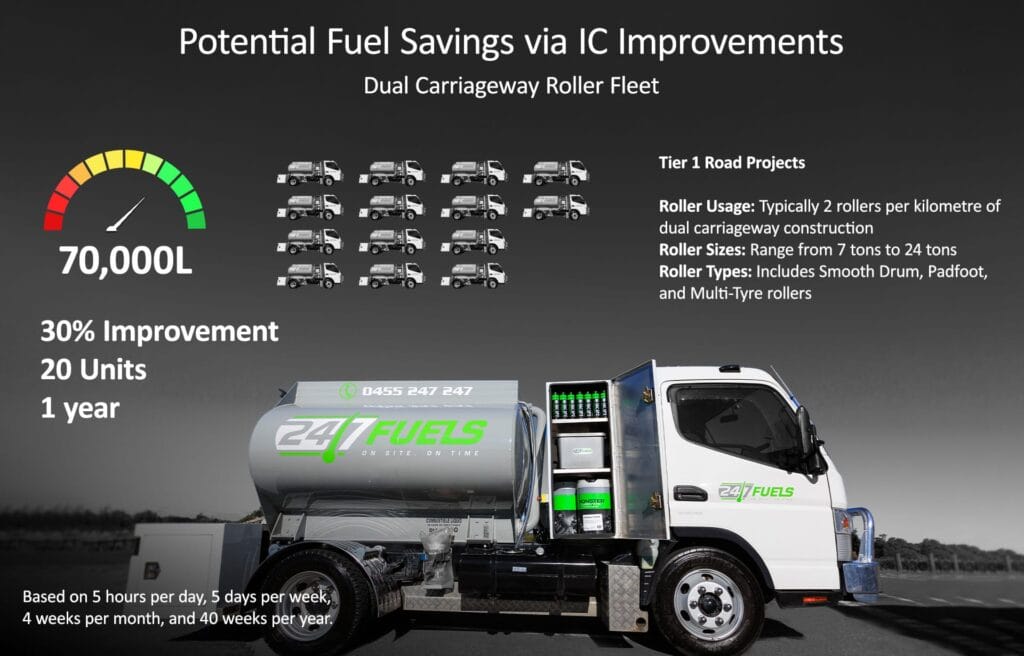
Völkel Intelligent Compaction (IC) solves this by giving operators real-time, in-cab feedback. Instead of guessing, they can see exactly when the target density has been reached and stop rolling. In one 9 km dual carriageway project, operators were averaging 10 passes when just two were required. The projected material cost alone was over $450,000. Völkel IC helped eliminate that risk.
With clear visual guidance, operators reduce fuel use and extend machine life and compact precisely to plan, not beyond it.
For transport and service vehicles:
- Route optimisation reduces distance and time on the road with operator fatigue
- Dispatching the nearest suitable unit, not just the default, avoids inefficiency
Monitoring delays (e.g. queuing or loading) helps refine workflows
3. Use Fuel Cards Strategically
Fuel cards aren’t just for convenience. When integrated into fleet management software, they help you:
- Lock in competitive pricing
- Control product purchase types and volume
- Detect anomalies by driver, site, vehicle or job
That’s control and visibility you can take straight to the bottom line.
4. Maintain Equipment for Fuel Efficiency
Servicing your fleet is about more than just uptime. Poorly maintained rollers and support vehicles burn more fuel, deliver inconsistent results and break down more often.
That’s why a structured maintenance program should also be treated as a fuel-saving strategy.
Stay on top of scheduled servicing to ensure engines are running efficiently, clean and cool. That means changing all filters, inspecting cooling systems, checking vibration operation and resolving minor issues before they become fuel-hungry faults.
Just as important are daily inspections. Spotting issues like fluid leaks, low tyre pressure, excess tyre or track wear, or changes in exhaust colour and reporting odd noises during operation can flag inefficiencies that directly affect fuel use.
Prevention always beats repair. And when it comes to fuel savings, it pays off fast.
Fuel efficiency also directly affects total engine hours. Excessive idling and unnecessary passes increase machine hours without increasing productive output. Higher hours accelerate wear on engines, hydraulics and vibration systems, bringing forward major service intervals and component replacements. Over time, that impacts not only maintenance costs but also resale value. A machine with inflated hours from poor fuel discipline will always command less in the secondary market than one that has been run efficiently and purposefully.
5. Match Machines to the Job
Using oversized or inappropriate equipment is one of the fastest ways to waste fuel. A 25-tonne roller might be powerful, but if the job’s compaction specification only calls for a 12-tonne machine, you’re burning more fuel than needed for no extra benefit. The same goes for drum selection: using a smooth drum on material that requires a padfoot will only lead to poor compaction results, more passes, more fuel and unnecessary wear. Choosing the right-sized machine with the right configuration means you finish faster, burn less fuel, achieve the correct compaction for your site and stretch your budget further.
6. Buy Fuel the Smarter Way
Buying fuel may seem straightforward, but how and when you purchase it can make a serious impact on operating costs. Bulk fuel can be a great option if you have the storage, security and high enough consumption to justify it. But for many businesses, well-managed fuel card programs offer more flexibility and competitive per-litre rates without the costly outlay of infrastructure overheads.
Tracking spend in real time is just as important. Whether you use basic logs or integrated software, knowing how much fuel is used by job, machine, or operator lets you quickly flag any anomalies, update project forecasts and keep all of your team accountable. Fuel purchasing doesn’t need to be complicated, but it should be managed strategically to lower your project’s bottom line.
7. Build a Long-Term Fuel Management Strategy
Start futureproofing your fleet
- Phase in more fuel-efficient machine models when possible.
- Explore hybrids or alternative fuel units if available
- Use fuel KPIs to guide purchasing decisions
Align with tender requirements
Many government and private tenders now require reporting on carbon and fuel efficiency. Showing proactive management puts you ahead of the pack.
Don’t Just Save Fuel, Create an Advantage
Improving fuel efficiency isn’t just about cutting costs, it’s about building a smarter, leaner and more competitive operation. Every litre saved means more money in your pocket, longer equipment life, and less environmental impact. But the real value comes when you embed these strategies into how your business runs, from daily decisions to long-term planning & estimating.
By adopting a fleet-wide fuel strategy, you gain more control, more insight and more confidence in your ability to deliver profitable, sustainable results, job after job.
Need help choosing the most fuel-efficient compaction equipment? Contact your local Conplant branch. Our team will help you choose the right gear and smart systems to reduce waste, improve performance and give your business an edge.