Australia’s road network is vast, varied, and unforgiving. From coastal corridors exposed to salt and humidity through to inland regions dealing with heat, heavy haulage, and expansive soils, the demands placed on pavement performance are relentless. Maintenance has always been a balancing act between cost, safety, and time. What is changing now is how those decisions are being made.
Artificial Intelligence is no longer a concept confined to software teams and data scientists. It is finding its way onto the road network itself, quietly reshaping how defects are identified, how interventions are prioritised, and how construction quality is delivered from the outset. Across Australia, councils and contractors are beginning to shift from reactive maintenance models to something far more informed, continuous, and predictive.
This is not about replacing experience on the ground. It is about augmenting it with better visibility, better data, and ultimately better outcomes.
Table of Contents
The pressure on road maintenance is not easing
Understanding how and why roads fail
From periodic inspections to continuous visibility
Automated defect detection is changing response times
Moving from reactive to predictive maintenance
Stretching maintenance budgets further
The role of intelligent equipment during construction
The pressure on road maintenance is not easing
Maintaining road assets across Australia has always been resource intensive. Large networks, dispersed populations, and exposure to extreme weather events all contribute to a constant cycle of deterioration. Potholes, cracking, rutting, and surface fatigue are not isolated issues. They are symptoms of broader structural behaviour, often accelerated by traffic loading, moisture ingress, and variability within the underlying materials.
What is becoming increasingly clear is that the challenge is not simply the presence of defects, but the way they are understood and managed. Initiatives such as NSW’s Asset AI case study highlight a growing recognition that traditional inspection and maintenance approaches are no longer sufficient at scale.
Historically, inspection regimes have relied on periodic surveys, visual assessments, and reactive reporting from road users. While these methods have supported network management for decades, they are inherently limited. They provide snapshots rather than a continuous understanding of network condition, and they rely heavily on defects becoming visible before action is taken.
By the time a defect is identified and scheduled for repair, it has often progressed beyond its most cost-effective intervention point. In practical terms, this means more extensive repairs, greater disruption, and increased cost.
This is where the role of AI begins to shift from innovation to necessity. It offers a way to move beyond episodic inspection towards continuous visibility, allowing maintenance strategies to be built on current, network-wide data rather than isolated observations.
Understanding how and why roads fail
To understand the value of AI in maintenance, it is worth stepping back and looking at what is actually happening within a pavement structure.
Most surface defects originate well below the wearing course. Traffic loading induces repeated stress cycles through the pavement layers. Where the supporting materials lack sufficient stiffness or have been inconsistently compacted, deformation begins to accumulate. Moisture ingress further weakens these layers, reducing effective stress and accelerating settlement.
Over time, this manifests as rutting, cracking, and ultimately surface failure. What is often treated as a surface problem is in reality a response to underlying variability. That variability may be due to material differences, inconsistent compaction, construction constraints, or environmental conditions.
This distinction matters. If the root cause sits below the surface, then a maintenance approach based purely on visible defects will always be reactive by nature. It addresses the outcome, not the process that led to it.
Traditional inspection methods identify the result of this behaviour. They do not provide insight into how quickly it is developing, how widespread it is, or where similar conditions are likely to emerge next. Without that context, maintenance decisions are made with limited visibility.
AI changes this by introducing continuity into the dataset. Instead of isolated inspections, it enables ongoing monitoring, allowing patterns of deterioration to be understood rather than simply observed.
From periodic inspections to continuous visibility
One of the most practical applications of AI in road maintenance has been the use of camera-based systems mounted on existing fleet vehicles. Rather than deploying dedicated inspection teams, councils are leveraging vehicles already travelling the network daily.
In initiatives such as the NSW Asset AI program, data capture is embedded into routine operations. Cameras mounted on service vehicles collect imagery as part of their normal routes, feeding information into machine learning models capable of identifying surface defects.
This represents a structural shift in how road networks are monitored. Inspection is no longer a scheduled activity. It becomes a byproduct of daily operations, significantly increasing coverage without increasing labour demand.
The Wollongong City Council’s approach demonstrates how this works in practice, with six waste collection trucks and four council vehicles equipped with forward-facing cameras that scan road conditions during routine runs. Defects are identified as they emerge, rather than waiting for periodic audits.
The Noosa Shire trial reinforces this model, using garbage trucks as continuous monitoring platforms. Rather than introducing new inspection resources, the council has embedded data capture into existing workflows, effectively turning a daily operational task into a persistent source of network intelligence.
The outcome is not just more data, but better timing. Roads are no longer assessed every few years. They are monitored continuously, allowing maintenance teams to work from current conditions rather than historical snapshots.
Automated defect detection is changing response times
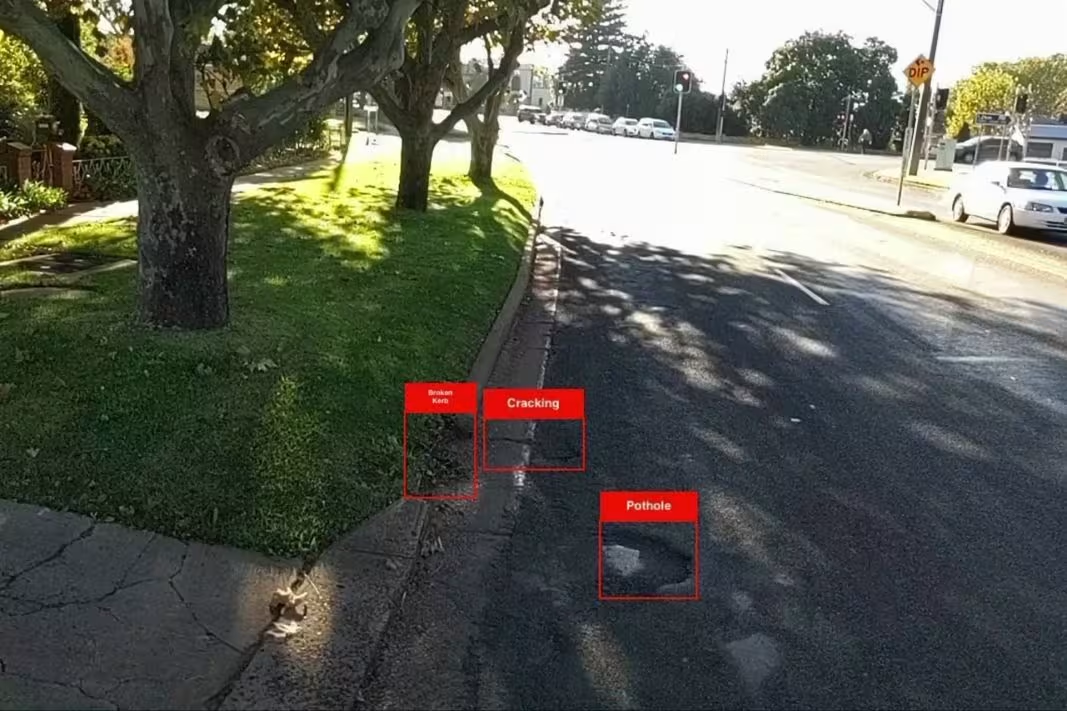
Once captured, the real strength of AI lies in how that data is interpreted. Machine learning models can be trained to recognise patterns associated with potholes, cracking, line marking degradation, and other forms of surface distress. More importantly, they can assign a level of severity and prioritise intervention based on risk.
In practice, the same fleets being used for data capture are now feeding directly into decision-making workflows. As seen in the Wollongong City Council’s approach, defects identified during routine runs are geotagged, categorised, and uploaded to asset management systems without manual intervention. This removes subjectivity from the initial assessment process and gives maintenance teams a clear, consistent view of where resources need to be allocated and why.
The impact is not just administrative. It materially reduces the time between identification and action. Instead of relying on fragmented reporting or scheduled inspections, teams are working from a continuously updated dataset that reflects actual network conditions.
The result is faster reporting, improved safety, and a more structured approach to maintenance planning. Instead of responding to isolated complaints or conducting broad inspections, teams can focus on high-risk areas with a clear understanding of the underlying condition.
Moving from reactive to predictive maintenance
The next step in this evolution is predictive maintenance. Once a consistent data stream is established, trends begin to emerge. AI systems can analyse how defects develop over time, identifying patterns that indicate when a section of road is likely to deteriorate beyond acceptable limits.
This shifts maintenance from reaction to anticipation. Rather than waiting for a pothole to form, interventions can be scheduled based on early indicators of surface fatigue or structural weakness. This approach not only reduces the likelihood of sudden failures but also allows maintenance to be planned in a way that minimises disruption to road users.
For councils managing constrained budgets, this has significant implications. Planned works are inherently more efficient than emergency repairs. They allow for better coordination, better procurement, and better utilisation of resources.
Stretching maintenance budgets further
Road maintenance represents a substantial portion of local government expenditure. The challenge is not just maintaining assets but doing so within tight financial constraints. AI introduces a level of precision that has the potential to fundamentally change how those budgets are deployed.
By identifying defects early and prioritising them effectively, minor issues can be addressed before they escalate into major rehabilitation works. This is where the real cost savings begin to emerge. Preventative maintenance is always more economical than reactive reconstruction, but it relies on knowing when and where to act.
Programs such as the NSW Asset AI trial have sought to quantify these benefits, targeting measurable improvements in maintenance efficiency and reductions in backlog.
There are also indirect savings to consider. Poor road conditions contribute to vehicle damage, increased accident risk, and unplanned closures. Each of these carries a cost, whether through claims, emergency works, or lost productivity.
Further examples, such as the City of Moreton Bay pothole program, demonstrate how targeted, data-driven interventions can reduce these risks and improve overall network performance.
The role of intelligent equipment during construction
While much of the discussion around AI in road maintenance focuses on identifying defects, the same thinking applies earlier in the lifecycle. Construction quality sets the baseline for how a road performs.
Compaction is central to that. If the surface layer is not uniformly compacted, weak spots develop that show up later as rutting, cracking, and early surface distress.
Traditionally, this has been checked through spot testing. Useful, but limited. It confirms a point, not the whole surface.
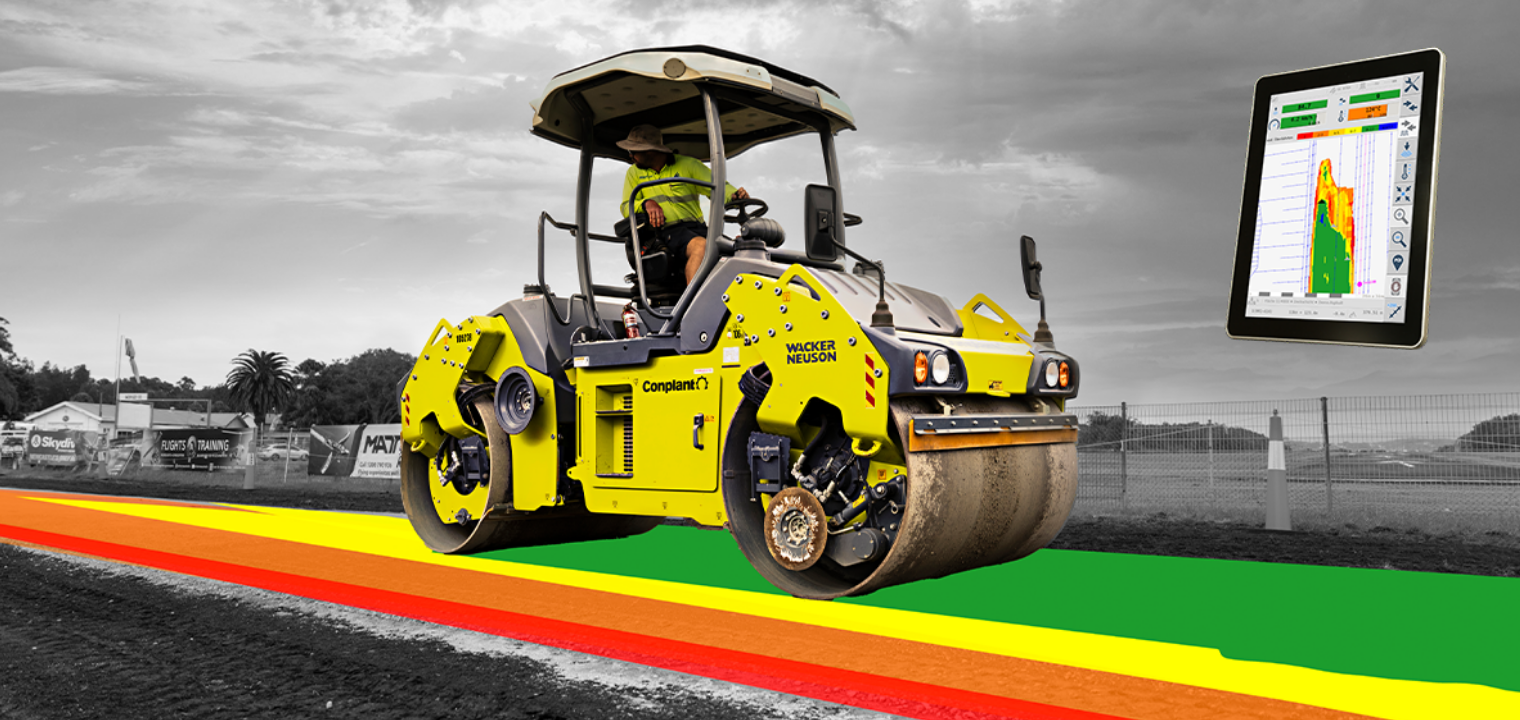
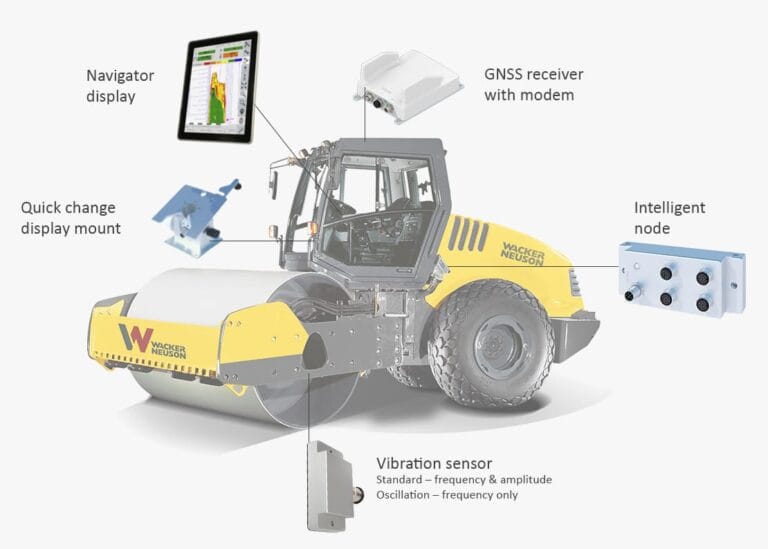
Intelligent compaction changes that. Systems such as Völkel Intelligent Compaction provide continuous feedback during rolling, giving operators visibility across the entire work area.
That visibility reinforces a simple principle: every pass counts. Instead of working to a fixed number of passes, operators can respond to what the surface is doing in real time. Under compacted areas can be addressed immediately, and unnecessary passes avoided.
The outcome is consistency across the surface, not just compliance at isolated points. And that consistency is what reduces the likelihood of defects forming later, linking construction quality directly to long-term maintenance performance.
A practical view of what comes next
AI in road maintenance is still evolving, but its direction is becoming clear. The value is not in isolated tools or trials, but in how these technologies are integrated into everyday operations.
For asset owners and contractors, the focus is shifting towards practical application. Where does it improve visibility? Where does it reduce rework? Where does it support better decisions on site?
That is where the real gains sit.
Final thoughts
The adoption of AI in road maintenance is not a future concept. It is happening now, across councils, contractors, and construction sites throughout Australia. From continuous defect detection to predictive maintenance and intelligent compaction, the industry is beginning to operate with a level of insight that was not previously possible.
The benefits are clear. Improved safety, more efficient use of resources, and better long-term performance of road assets.
As the industry continues to evolve, the integration of AI will become less about innovation and more about standard practice. Those who embrace it early and apply it thoughtfully will be best positioned to deliver the outcomes that modern infrastructure demands.
Ultimately, whether through data captured on the road network or feedback delivered through intelligent compaction on site, the direction is the same. Greater visibility leads to better decisions, and better decisions lead to more consistent outcomes.
Because at every stage of the lifecycle, from construction through to maintenance, the principle remains unchanged. Every pass counts.
The road network may be ageing, but the way we maintain it is rapidly moving forward.