Introduction to the Australian Construction Industry
Australia’s construction industry is one of the nation’s most vital economic engines. With a population that reached 27.7 million as of September 2025 – growing at 1.6% year-on-year – and ABS projections pointing to between 29.2 and 30.8 million Australians by 2032, the demand for housing, infrastructure, and commercial space shows no sign of slowing down.
This article reviews the current state of the construction industry in Australia in 2026: its size, structure, workforce, key challenges, emerging technologies, and the pipeline for the years ahead.
Contents:
Current Landscape of the Construction Industry in Australia
Residential Construction Sector
Commercial and Public Construction Sector
The Role of Technology and Innovation
Key Challenges Facing the Construction Industry
Regulatory Changes Shaping the Industry
Economic Significance of the Construction Sector
Construction is a major pillar of the Australian economy. According to the ABS’s Nuts and Bolts of the Australian Construction Industry (June 2025) and NT Treasury and Finance’s industry analysis, the sector accounted for approximately 7.2% of national GDP in 2024-25, with the ABS also reporting a 7.0% share in 2023-24. In value-added terms, the ABS Australian Industry 2024-25 release estimated the industry’s value added at $191.8 billion in 2024-25.
It is worth noting that industry income figures – which the ABS reports at $633.6 billion for 2023-24 – include contracting and subcontracting flows between firms and are not the same as the industry’s GDP contribution. The value-added measure is the more appropriate lens for assessing economic scale.
Beyond the headline numbers, construction has strong ripple effects across manufacturing, logistics, real estate, and professional services. When construction activity rises, so does demand across a wide network of supporting industries.
Overview of Key Segments
The construction industry in Australia operates across three broad sub-sectors:
- Residential construction – houses, apartments, townhouses, and medium-density developments
- Non-residential and commercial construction – offices, retail, industrial facilities, and institutional buildings
- Heavy and civil engineering – roads, rail, bridges, energy infrastructure, and utilities
Each segment responds to different drivers – residential activity tracks population growth and interest rates closely, while civil engineering is heavily influenced by government budget cycles and long-term infrastructure pipelines.
Current Landscape of the Construction Industry in Australia
Market Size and Performance
Recent official data paints a picture of a sector that remains substantial, even as different segments move at different speeds.
The ABS Construction Work Done Report, December 2025, stated that total construction work done fell 0.1% to $80,011.8 million in the December 2025 quarter (seasonally adjusted, chain volume measures). Within that, building work rose 0.9% to $44,103.4 million, while engineering work eased 1.3% to $35,908.4 million. On an annual basis, total construction work done was up 3.0% year-on-year to December 2025.
The ABS Australian Industry 2023-24 annual release shows that the construction industry value added increased 8.6% in 2023-24, reflecting the strong government-funded pipeline keeping the broader sector active even as private residential projects faced headwinds from higher interest rates.
Note: ABS “work done” figures are expressed in chain volume measures and seasonally adjusted. These reflect activity volumes rather than nominal dollar values and are the most reliable basis for comparing construction performance over time.

Major Players and Market Share
Australia’s construction landscape includes major national and international contractors alongside numerous small- to medium-sized enterprises. Companies such as CIMIC Group, Downer and John Holland are prominent across large-scale civil and infrastructure projects. However, smaller contractors and specialist operators remain an important part of the residential, civil and fit-out markets, creating a highly competitive industry.
Recent Performance Trends
The period from 2020 to 2025 was among the most turbulent in living memory for Australia’s construction industry. The COVID-19 pandemic disrupted supply chains, stalled major projects, and accelerated material cost inflation. Government stimulus programmes – including HomeBuilder – briefly supercharged residential commencements before a sharp correction followed.
By 2025 and into 2026, the picture has stabilised somewhat. Transport and energy infrastructure remain the strongest segments, supported by substantial government pipeline commitments. The residential market, particularly multi-unit construction, is showing signs of recovery after a prolonged trough in commencements.
Key Statistics and Data
Here is a snapshot of the most current official data for the construction industry in Australia, drawn primarily from the ABS and Jobs and Skills Australia.
Australian Construction Industry – Key 2025-26 Data
- Total construction work done: $80,011.8 million in the December 2025 quarter (seasonally adjusted, chain volume)
- Building work done: $44,103.4 million (+0.9% for the quarter)
- Engineering work done: $35,908.4 million (-1.3% for the quarter)
- Year-on-year growth: Total construction work up 3.0% to December 2025
- Industry value added: $191.8 billion in 2024-25 (ABS)
- Total industry income: $633.6 billion in 2023-24 (ABS, noting this is not the same as GDP contribution)
Source: ABS Construction Work Done (Dec 2025), ABS Australian Industry (2023-24)
With constant pressure on building timelines, on-site safety is a priority. Learn more about Compaction and Construction Equipment Safety.

Employment Figures
Construction is one of Australia’s largest employers. Trend labour force data from Jobs and Skills Australia (April 2026) show 1,371,500 people employed in construction as at February 2026, representing 9.3% of the total Australian workforce. On an annual business-survey basis, the ABS Australian Industry 2024-25 release recorded construction employment at 1.313 million at the end of June 2025.
These figures represent a significant increase over the 1.2 million commonly cited in earlier reporting and are well ahead of the 1.26 million forecast for 2025 in industry outlooks published a few years ago. The industry has proven more resilient as an employer than some projections anticipated, driven by the sustained infrastructure pipeline.
Despite the solid headline numbers, the sector continues to grapple with a structural skills shortage. Demand for electricians, plumbers, carpenters, and civil engineers consistently outstrips supply, contributing to project delays and cost pressures across the industry.
Private vs Public, Residential vs Non-Residential
Public and private funding both play significant roles in sustaining the construction industry in Australia. In the December 2025 quarter, ABS engineering construction data show work done valued at $19.6 billion for the private sector and $16.2 billion for the public sector (seasonally adjusted, chain volume measures).
Across all construction activity, building work made up 55% of total work done in the December 2025 quarter, with engineering accounting for the remaining 45%. This balance illustrates why shifts in government infrastructure spending can have such a pronounced effect on overall industry performance.
In terms of the overall mix, residential building work ($27.1 billion) plus engineering construction ($35.9 billion – a practical proxy for infrastructure) made up approximately 78.7% of total construction work done in the December 2025 quarter, leaving roughly 21.3% as non-residential building work. (Calculated from ABS Construction Work Done, Dec 2025.)

Residential Construction Sector
Housing indicators have been volatile but are showing encouraging momentum heading into 2026. In February 2026, the ABS Building Approvals release reported that total dwellings approved rose 29.7% (seasonally adjusted) to 19,022 – driven by a sharp lift in multi-unit approvals.
Residential Approvals – February 2026 (seasonally adjusted)
- Private sector houses: 9,847 (+0.2%)
- Private sector dwellings excluding houses: 8,922 (+101.2%)
- Value of total residential building approvals: $12.50 billion (+30.8%)
Source: ABS Building Approvals, Australia, February 2026 (released 1 April 2026)
It is worth noting that monthly building approvals can be volatile, particularly for the multi-unit category. Looking at actual commencements provides a steadier read on activity. ABS building activity data show total dwellings commenced rose 8.0% in the December 2025 quarter (seasonally adjusted) to 53,567 dwellings. New private house commencements edged down 0.9% to 28,469, while other private residential commencements jumped 23.4% to 23,849, reflecting the early signs of a recovery in apartment construction that industry bodies have been anticipating.
Commercial and Public Construction Sector
The commercial and public sectors remain major forces in Australia’s construction industry. The ABS Australian Industry 2024-25 release places construction industry value added at $191.8 billion in 2024-25, up 7.9% from the previous year.
On the public pipeline, the Infrastructure Australia 2025 Market Capacity Report estimates the five-year Major Public Infrastructure Pipeline at $242 billion across 2024-25 to 2028-29 – an increase of 14% compared with the prior year’s outlook. Transport dominates the pipeline at $129 billion (53%), followed by buildings at $77 billion (32%) and utilities at $36 billion (15%).
New South Wales, Victoria, and Queensland remain at the forefront of this infrastructure push, with projects spanning transport, energy, water, and social infrastructure. The scale of committed investment provides considerable forward visibility for contractors and subcontractors working in the civil sector.
The Role of Technology and Innovation
Digital transformation is reshaping the construction industry in Australia at pace. The adoption of Building Information Modelling (BIM), digital twins, and enterprise resource planning (ERP) systems is helping firms streamline workflows, reduce rework, and improve cost control across complex projects.
Prefabrication and modular construction are gaining traction, particularly for residential and social housing projects where speed of delivery matters. These methods reduce on-site waste and weather-related delays, making projects more predictable.
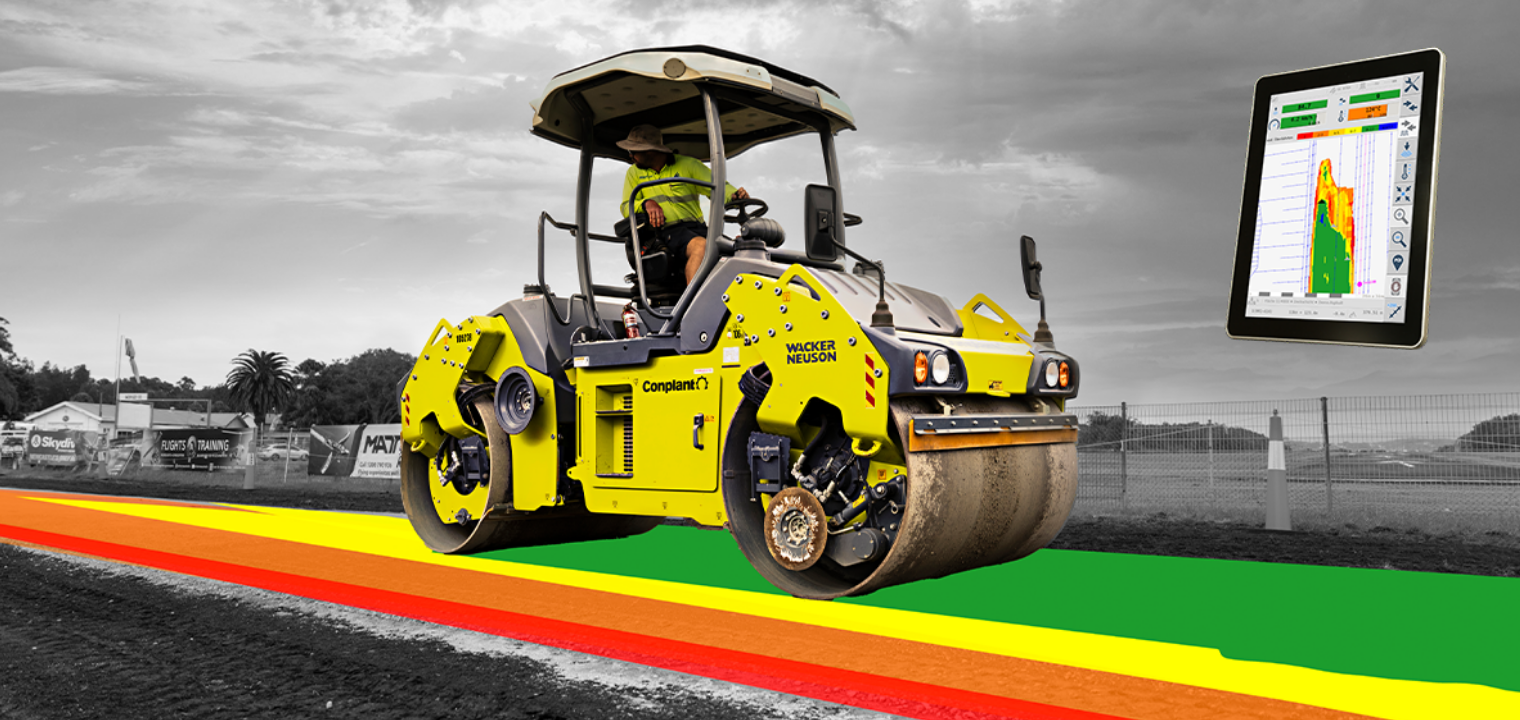
Conplant’s innovation division is a good example of how technology is reshaping site equipment in Australia – from intelligent compaction solutions to collision warning systems that improve safety and precision on civil projects.
The use of recycled materials and a focus on Green Star and NABERS certifications continue to grow, partly driven by market demand and increasingly by regulatory obligation. Embodied carbon – the emissions associated with materials like steel and cement – is drawing greater scrutiny, with the industry beginning to quantify and reduce its contribution across the project lifecycle.
Drone surveying, autonomous compaction equipment, and intelligent machine control are also becoming more common on larger civil projects, improving safety and accuracy while reducing manual labour requirements. For more on-site safety best practices, see Conplant’s guide to compaction and construction equipment safety.
Key Challenges Facing the Construction Industry
Labour and Skills Shortages
The skills shortage remains the most persistent structural challenge for the construction industry in Australia. Demand for qualified tradespeople – electricians, plumbers, carpenters, concreters – consistently outstrips supply. Project timelines are stretched, and wage pressures have contributed to broader cost escalation across the sector.
Addressing the gap requires a coordinated approach: investment in vocational training, strengthened partnerships with TAFEs and registered training organisations, expanded skilled migration programmes, and renewed efforts to attract women into the trades. At present, women represent approximately 13% of the construction workforce (Jobs and Skills Australia; Infrastructure Australia, 2025) – a figure that has barely shifted and represents both a challenge and a significant untapped opportunity for the sector.
Cost Escalation and Budget Pressures
Material costs, wage inflation, and the compounding effects of supply chain disruption have, in many cases, pushed project budgets well beyond their original estimates. Cost escalation in the construction sector has been running at elevated levels, with figures of 4.5-6.5% cited across major markets in 2025, with Brisbane among the highest.
High-profile examples of cost overruns on public projects – including the North East Link project in Victoria – have intensified scrutiny of project governance and procurement practices. Mitigation strategies that are gaining traction include value engineering, lean construction methods, and structured early contractor involvement to identify cost risks before they become locked in.
Project Deferrals and Insolvencies
The residential construction sector, in particular, has faced project delays, deferrals and elevated levels of business failure in recent years. ASIC recorded 2,975 construction industry insolvencies in 2023-24, representing 27% of all company insolvencies during the year. Cost escalation, labour shortages and the impact of fixed-price contracts agreed during the low-rate environment have contributed to financial pressure across parts of the sector.
This has had flow-on effects for subcontractors and suppliers who depend on a steady pipeline of work from head contractors. The situation has broadly stabilised in 2025-26, but many smaller operators remain financially stretched.
CHALLENGES | OPPORTUNITIES |
Rising costs:
| Cost-saving alternatives:
|
Supply chain disruptions:
| Strengthening resilience:
|
Labour and skills shortages:
| Workforce development:
|
Regulatory complexity:
| Technology and compliance:
|
Regulatory Changes Shaping the Industry
National Construction Code (NCC) Updates
The National Construction Code 2022 was adopted from May 2023, with implementation timelines for some requirements varying across states and territories. The updated code introduced changes covering areas such as energy efficiency, structural integrity, bushfire protection and accessibility. For construction businesses, these requirements have increased compliance complexity and, in some cases, upfront construction costs, particularly where higher energy performance standards apply to new residential buildings.
Mandatory Sustainability Reporting
From January 2025, Australia’s mandatory climate-related financial reporting requirements began applying to the largest entities, including eligible construction firms, under the Treasury Laws Amendment (Financial Market Infrastructure and Other Measures) Act 2024. The requirements are being introduced progressively and include reporting on Scope 1 and Scope 2 greenhouse gas emissions, with Scope 3 emissions also required subject to transitional relief during the first reporting period.
For the construction industry, Scope 3 reporting is particularly significant given the upstream emissions embedded in materials supply chains. Firms that move early to measure and reduce embodied carbon are likely to benefit from stronger investor confidence and greater competitiveness in tenders.
Decarbonising Infrastructure Delivery (NSW)
New South Wales introduced its Decarbonising Infrastructure Delivery Policy effective April 2025, applying to projects over AUD 50 million for buildings and AUD 100 million for infrastructure. Requirements include carbon management plans, prioritisation of low-carbon materials, and emissions tracking through the project lifecycle. Other states are closely watching this policy and may foreshadow similar requirements nationwide.
Future Outlook for the Construction Industry in Australia (2026-2030)
Forecasted Growth and Opportunities
The outlook for the construction industry in Australia is broadly positive, supported by structural demand drivers and committed government investment. Population growth – both natural increase and migration – is creating sustained demand for housing and enabling infrastructure.
The residential sector is showing early signs of a recovery cycle in 2026, particularly for multi-unit construction, as approvals data and commencements tick upward. Industry forecasters, including the Housing Industry Association (HIA), have highlighted the apartment cycle as one to watch, driven by improving project economics and pent-up demand from years of undersupply.
On the infrastructure side, the $242 billion Major Public Infrastructure Pipeline, as tracked in the Infrastructure Australia Market Capacity Report 2025, provides considerable forward visibility. Transport remains the dominant category, but social infrastructure (hospitals, schools, justice) and utilities (energy transition infrastructure, water) are also significant contributors.
Addressing Challenges for Long-Term Resilience
Sustained investment in skills and training is the most critical lever for the industry’s long-term health. Without a larger pool of qualified workers, pipeline commitments risk creating bottlenecks that inflate costs and extend project timelines. Government-industry partnerships in vocational education and apprenticeship support will be essential.
Technology adoption – from ERP systems and digital twins to intelligent compaction equipment – offers a practical path to doing more with the available workforce. Firms that invest in these capabilities now are likely to outperform on both productivity and cost control as the pipeline ramps up.
Regional Opportunities
New South Wales continues to lead in terms of construction pipeline volume, particularly in transport, apartment, and commercial construction. Queensland’s strong population growth is driving sustained demand for residential and infrastructure, though cost pressures remain elevated. Victoria’s major infrastructure programme, while subject to budget recalibration in some areas, still represents a substantial multi-year pipeline for the civil sector.
Strategies for Success in Australia's Construction Industry
Adopt Technology for Efficiency
Businesses that have implemented ERP systems, BIM, and drone surveying are consistently reporting improved project outcomes – reduced cost overruns, fewer delays, and better safety records. Digital tools are no longer a competitive advantage for early adopters; they are fast becoming a baseline expectation for clients and head contractors. Explore Conplant’s innovative construction equipment solutions to see how technology is being applied on Australian sites today.
Build a Skilled Workforce
Collaborating with TAFEs, universities, and registered training organisations to develop targeted vocational programmes is one of the most effective ways construction businesses can manage their workforce pipeline. Promoting apprenticeships, trade certifications, and diverse hiring practices – including actively recruiting more women into the sector – will also be essential for firms looking to grow sustainably.
Navigate Regulatory Compliance Proactively
The regulatory environment for the construction industry in Australia is becoming more complex, not less. Firms that invest in understanding their obligations – particularly around sustainability reporting and carbon reduction – and put systems in place ahead of deadlines will be better positioned than those that treat compliance as an afterthought. Data-driven feasibility studies and early contractor involvement in project design are increasingly valuable tools for managing compliance risk.
Summary
The construction industry in Australia remains one of the economy’s most important sectors, employing over 1.37 million Australians, contributing approximately 7.2% of national GDP, and backed by a $242 billion public infrastructure pipeline stretching to 2028-29.
The challenges are real – skills shortages, cost pressures, regulatory complexity, and the lingering effects of a difficult period for residential construction. But so are the opportunities: a recovering housing market, a substantial and committed government pipeline, and the transformative potential of technology adoption.
Firms that invest in their people, embrace digital tools, and engage proactively with sustainability requirements are well placed to capitalise on what promises to be an active construction market in the years ahead.
Need a hand with equipment hire, purchase, or servicing? Get in touch with the Conplant team – we’ve been supporting the Australian construction industry for decades and understand the unique demands of site work, compaction, and civil construction.