In 2026, landscaping crews are doing more with less: less time, fewer people, stricter safety compliance and tighter access. Staying productive means working smarter, not harder, and often that comes down to having the right gear in place when you need it.
This article shares practical equipment-based strategies to help avoid slowdowns, reduce clutter, and keep projects moving smoothly. Whether you’re running a small residential crew or managing multiple commercial sites, these tips are designed to reflect how landscaping teams work and how the right gear can help, without disrupting your flow.
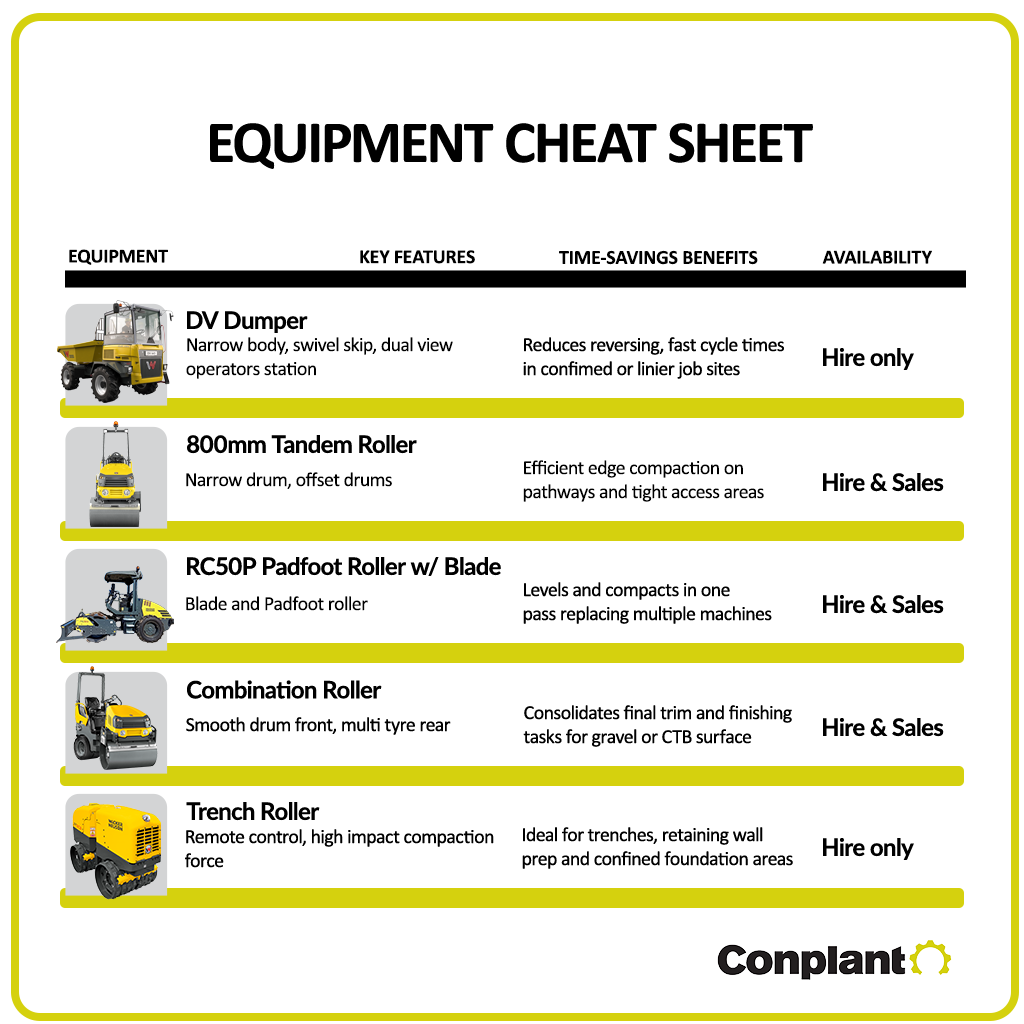
Want a quick glance summary? Download our Landscaping Equipment Cheat Sheet, a visual guide to compact equipment options that can help you work more efficiently.
Contents:
1. Pick Equipment That Matches the Job (Not Just What’s Available)
2. Use Versatile Equipment and Attachments
3. Prioritise Compact Gear That’s Built for Tight Access
4. Take Advantage of Built-In Efficiency Features
1. Pick Equipment That Matches the Job (Not Just What’s Available)
Most delays in landscaping come down to mismatched machines. It’s not always about getting the biggest or most powerful tool; it’s about selecting gear that fits your task and your site.
Let’s say you’re removing soil from a tight backyard with limited access. A standard dumper might need multiple turns and repositioning, whereas a compact dumper with a swivel skip and Dual View seat allows the operator to rotate and tip without reversing. That means faster cycles, fewer risks, and less disruption to finished areas.
For spreading or levelling on a small house pad, using a padfoot roller with a blade lets one operator prep and compact without needing a second machine like a skid steer or loader.
Or consider long, narrow runs, pathways, driveways, even edging along retaining walls. Tandem rollers with 800mm wide drums with offset drums can handle this quickly and neatly, where a plate compactor would take hours.
Real-World Tip: Ask your operator what’s slowing them down. The answer is often related to machine size, turning room, or time lost repositioning.
2. Use Versatile Equipment and Attachments
Every time you swap machines, you lose time, whether it’s waiting for a delivery, unloading gear, or coordinating between operators. Multi-function equipment and smart attachments give you the flexibility to cover more ground with fewer tools.
If you’re working on a driveway that needs both levelling and compaction, a padfoot roller with blade can replace the usual combo of grader, skid steer and roller.
Similarly, finishing off a mixed soil, gravel, asphalt or cement-treated base with a combination roller (smooth drum front, multi-tyre rear) saves the trouble of bringing in separate steel drum and multi-tyre units. These machines are commonly used on rural driveways, horse arenas, and light roads where both vibratory compaction and a clean finish are needed.
Real-World Tip: Versatility isn’t about doing everything; it’s about reducing transitions and helping crews focus on progress.
3. Prioritise Compact Gear That’s Built for Tight Access
Landscaping jobs aren’t just wide-open construction pads. You’re working near often sensitive structures, above or near utilities, around trees and garden beds, or through narrow gates or garages. Compact, manoeuvrable machines are built for these applications.
Take the Dual View Series dumper. With its narrow footprint, swivel skip, and rotating operator station, it’s ideal for backyards, paths and courtyards and tight access building sites. The operator stays seated, moves quickly, and avoids needing a spotter in tight zones.
The 800mm drum tandem roller is another example. It’s compact enough to navigate tighter curves and borders but has the vibratory compaction force and stability to handle paths, pavers, smaller asphalt jobs and base prep better than a plate.
Real-World Tip: These aren’t just smaller versions of big gear. They’re specialist tools made to do compact jobs properly. See how we support compact equipment solutions.
4. Take Advantage of Built-In Efficiency Features
Not every time-saver is obvious, but small built-in features can make a huge difference in daily productivity.
- Drum offset on tandem rollers allows for overlapping passes, which means compacting right up to kerbs, walls & piers or fencing with ease.
- Swivel skips let dumpers place material precisely without reversing into tight corners.
- Dual View seating removes the need to spin the dumper around onsite, just rotate the seat and keep moving forward.
These are features that operators use constantly on-site. They reduce the need for rework, improve visibility, and site safety by reducing any unnecessary manoeuvring, especially in confined workspaces.
Real-World Tip: One operator using well-specked gear can often outwork two with basic equipment.
5. Maintain Equipment to Avoid Costly Downtime
Even the best equipment becomes a liability if it’s not maintained. Crews can’t move forward when a machine’s down, and even small delays impact timelines.
- Start with pre-start checks — they take 5 minutes and catch simple issues like loose fittings, fluid levels or worn edges and tyres.
- Stick to the service schedule. Whether you own the gear or hire it, planned maintenance keeps things running. Letting machines go too long between services often results in bigger failures and higher operating costs.
- Using hire gear? Ask for a machine’s service history or, if available, access telematics data to track hours and usage.
Real-World Tip: On jobs with back-to-back deadlines, the most productive machine is the one that’s working when you need it.
Bonus: Quick Equipment Planning Checklist
Before starting your next landscaping project, run through this:
- What’s the access like — width, slope, surface?
- Can one machine cover multiple tasks (e.g. level and compact)?
- What’s the total footprint of machines being used?
- Are operators trained on any efficiency features like offset steering or Dual View?
- Is your gear maintained, checked, and ready to go?
These questions help avoid last-minute reshuffles or unnecessary delays.
Wrap-Up: Smarter Gear = Smoother Jobs
Landscaping teams already know how to work hard. The next gains are about working smart through better planning, more appropriate gear, and a bit of foresight.
Here’s a recap of the five moves that can unlock better output on site:
- Choose equipment that fits the job, not just what’s available
- Use multi-purpose gear to reduce downtime and transport
- Select compact machines for tight access and detailed work
- Make the most of built-in features that save time and effort
- Maintain equipment so your schedule stays on track
And if you’re not sure what’s right for the next job, that’s where we come in.
 Download the Landscaping Equipment Cheat Sheet — a quick-reference PDF covering compact machines commonly used in landscaping jobs, with advice on where and how they’re most effective.
Need advice on a specific setup? Talk to the team at Conplant.