Australia’s infrastructure sector is increasingly being shaped by a factor that sits outside traditional engineering controls: heat.
Across many urban and peri-urban areas, road surface temperatures during summer are reaching extremes. Black asphalt in outer suburbs has been recorded at around 75 °C, as highlighted in this ABC report. These temperatures are not just uncomfortable; they materially influence how pavements perform, accelerating oxidation, softening binders, and increasing the rate of surface deformation.
Urban Canopy as Infrastructure Strategy
At the same time, a parallel shift is taking place in planning policy. Governments and councils are introducing urban canopy targets at scale; positioning tree cover as a core component of climate resilience. Greater Sydney’s commitment to planting five million trees by 2030, as discussed in urban canopy initiatives, reflects a broader national trend toward integrating green infrastructure into urban systems.
What is becoming increasingly clear is that this is not just an environmental initiative. It is an infrastructure strategy.
The relationship between tree canopy and road performance starts with something simple: shade.
Field observations and thermal imaging have shown that unshaded asphalt can be approximately 15 °C hotter than pavement beneath tree cover. For pavement materials, that temperature difference is significant. Lower peak temperatures reduce thermal expansion, limit binder softening, and decrease the likelihood of rutting and deformation under load.
However, the cooling effect extends beyond shade alone. Trees actively moderate their environment through evapotranspiration, releasing water vapour that cools surrounding air and surfaces. Work undertaken by CSIRO in Darwin, outlined in the Darwin Living Lab research, recorded surface temperature reductions of up to 21 °C under tree cover compared to exposed areas.
Beyond temperature control, the tree canopy also plays a role in managing water. Root systems improve soil permeability and help absorb excess moisture during heavy rainfall events, reducing surface runoff and pressure on drainage systems. In urban environments, this complements emerging approaches such as permeable pavements, which aim to manage water at the source rather than relying solely on downstream infrastructure.
This dual mechanism, shading and active cooling, reduces both peak and cumulative heat exposure. For infrastructure, that translates to less stress over time.
Heat is one of the most consistent, yet often underestimated, drivers of pavement deterioration. Elevated temperatures accelerate oxidation, reduce material flexibility, and increase susceptibility to cracking and surface failure. When these effects are repeated over successive heat cycles, the impact compounds.
The tree canopy effectively acts as a protective layer. By shielding pavement from direct solar radiation and moderating surrounding temperatures, it slows the degradation process. Shaded streets tend to experience lower maintenance demands and longer service intervals, as highlighted in research on canopy and infrastructure value.
From a technical standpoint, this protection influences several key deterioration mechanisms. Lower surface temperatures reduce binder ageing and oxidation, helping asphalt retain flexibility for longer. Reducing thermal cycling limits, the formation of micro-cracking, which can otherwise propagate into larger defects under traffic loading. In granular layers, moderated temperatures help maintain moisture equilibrium, reducing shrink-swell behaviour and preserving layer stability.
There is also a direct impact on structural performance. By limiting heat-induced softening at the surface, the canopy helps maintain load distribution through the pavement structure, reducing localised deformation and rutting under repeated loads. Over time, this contributes to more consistent modulus across the treated area, supporting better long-term performance outcomes.
This reinforces that the canopy is not simply preserving surface condition; it is influencing how the pavement structure behaves under load over time.
Construction Considerations in High Heat
From a construction perspective, this has direct implications for how work is carried out on site. Elevated surface temperatures narrow compaction windows, change material behaviour under load, and increase variability in achieved density. Asphalt can remain workable for longer but also becomes more susceptible to displacement and over-compaction if not managed correctly.
In high-temperature environments, where material behaviour is less predictable, and compaction windows are compressed, this challenge becomes more pronounced. It is in these conditions that real-time feedback and control become critical, allowing crews to adjust on the fly, maintain consistency across variable conditions, and deliver a finished surface that aligns more closely with design intent.
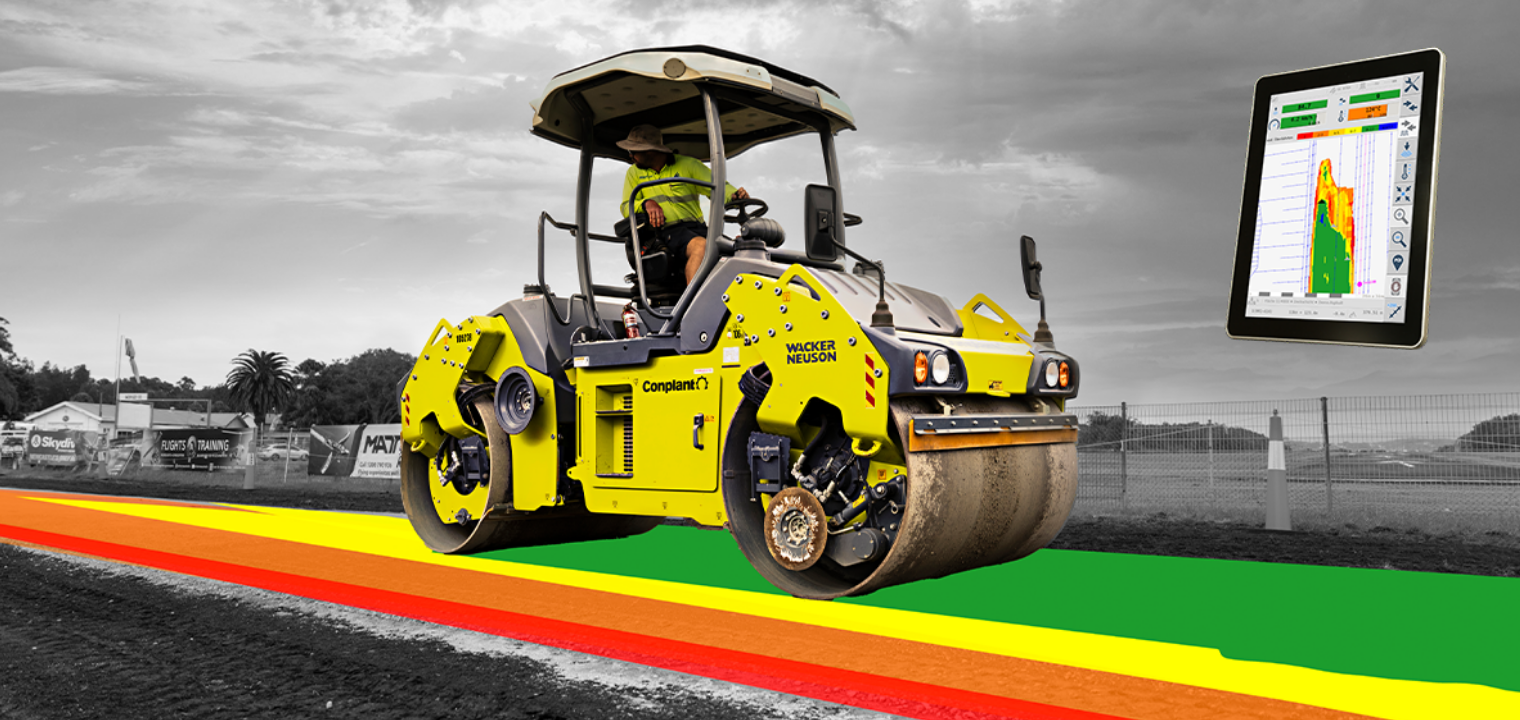
This is where technologies such as Völkel Intelligent Compaction are changing how these risks are managed in real time. By using GNSS positioning and vibration sensors, the system measures drum response, material stiffness, temperature and pass counts, giving operators live feedback on what is happening beneath the drum rather than relying on experience alone. In heavily vegetated corridors, satellite visibility can be reduced, which can impact GNSS accuracy. However, modern systems incorporate advanced tracking algorithms and correction methods to maintain positioning reliability in these environments.
For rollers, this shifts compaction from a process of estimation to one of control. Operators can see exactly where additional passes are required and, just as importantly, where they are not. This reduces the risk of over-compaction, which can degrade material structure, lower layer thickness and introduce long-term performance issues. It also improves uniformity across the site by identifying soft spots and inconsistencies as they occur, rather than after the fact.
Heat also affects plant performance. Tyre pressures, hydraulic efficiency, and cooling systems are all placed under greater demand, particularly during long summer shifts. Operators are often forced to adjust work sequences, increase downtime, or shift to early morning and night work to maintain productivity and quality outcomes. In extreme conditions, even access and safety become considerations, with surface temperatures impacting crew fatigue and machine handling.
What this highlights is that heat is not just a material issue. It is an operational constraint that influences construction methodology, equipment performance, and ultimately the consistency of the finished asset.
Asset Performance and Lifecycle Outcomes
From an asset management perspective, this shifts the conversation. Urban trees are no longer just part of the streetscape. They become part of the infrastructure system itself, contributing to lifecycle performance and cost efficiency.
The benefits extend beyond the pavement.
Urban heat does not operate in isolation. It influences how people experience and interact with infrastructure. In Western Sydney, studies have shown that street tree shade can reduce daytime air temperatures by approximately 3.9 °C compared to exposed areas, as explored in urban cooling research.
At a broader scale, the urban heat island effect continues to amplify temperature differences between built-up and vegetated areas. Areas with limited tree cover can be several degrees hotter than surrounding suburbs, increasing both infrastructure stress and health risks for communities.
Tree canopy disrupts this cycle. By reducing heat absorption and moderating air temperatures, it improves not only infrastructure performance but also liveability. For road users, pedestrians, and nearby residents, this translates to safer and more comfortable environments during extreme heat events.
There is also a practical benefit during construction. Shaded work environments can allow more activity to be undertaken during daylight hours, reducing the need for night works in heat-affected areas. This helps limit disruption to surrounding communities while also improving working conditions for crews.
Across Australia, this understanding is now being embedded into planning frameworks.
Local governments are setting canopy targets that align directly with resilience outcomes. Adelaide is working toward increasing canopy cover from 33% to 40% by 2035, with modelling suggesting this could reduce pavement temperatures by more than 9 °C. Similar targets have been adopted in Melbourne and Brisbane.
At the state level, programs such as NSW’s Greening Our City program are scaling these efforts. The commitment to large-scale tree planting reflects a recognition that traditional engineering responses alone are not sufficient to manage future climate conditions.
What is emerging is a coordinated approach, where green and grey infrastructure are designed to work together.
Real-World Example: Darwin
Darwin provides a clear example of how this integration can deliver measurable outcomes in a high-heat, high-humidity environment.
Following significant canopy loss during Cyclone Marcus in 2018, large sections of the city were left exposed. Road corridors that previously benefited from shade were suddenly subject to direct solar loading, increasing surface temperatures, accelerating pavement ageing, and amplifying the urban heat island effect.
In response, the City of Darwin, supported by CSIRO’s Living Lab program, undertook a targeted canopy restoration program. More than 12,500 trees have been planted across streets and public spaces, as detailed in the Darwin infrastructure progress report, with a focus on corridors most affected by heat exposure.
The outcomes have been measurable. Thermal monitoring has shown that shaded pavements experience significantly lower surface temperatures, reducing peak heat loads and limiting the rate of binder degradation. In a tropical climate, where high temperatures are combined with elevated moisture conditions, this has a compounding benefit. Lower surface temperatures help stabilise the pavement structure, reducing softening at the surface and limiting moisture-driven variability in underlying layers.
From a construction and maintenance perspective, this has practical implications. Crews are working in more stable conditions, with reduced variability in material behaviour across the site. Maintenance cycles are becoming more predictable, as heat-related defects such as rutting and surface deformation are less prevalent in shaded sections.
What Darwin demonstrates is that the canopy is not a theoretical overlay to infrastructure planning. It is an active control on environmental conditions that directly influence how pavements perform, how they are constructed, and how long they last.
Implications for Construction and Infrastructure
For the construction and infrastructure sector, the implication is clear.
Urban canopy should not be viewed as an external or secondary consideration. It is part of the system that influences how roads perform over time.
This integration must also be managed carefully. Root systems can interact with pavement layers and underground utilities if not properly considered during design. Species selection, root barriers, and coordinated planning between civil and landscape disciplines are critical to ensuring that canopy benefits are realised without introducing new maintenance challenges.
By integrating canopy planning with road design, construction, and maintenance strategies, it becomes possible to:
- reduce long-term maintenance requirements
- extend pavement life
- improve performance under extreme heat
- enhance outcomes for the communities those roads serve
This is not about replacing traditional engineering approaches but strengthening them through better control of the conditions that drive performance.
As temperatures rise, resilience will increasingly be defined by how well infrastructure manages heat at the source. Urban canopy provides a practical, evidence-based way to do this, reducing thermal stress on materials, improving consistency during construction, and supporting long-term pavement behaviour.
The shift is already underway. The opportunity now is to integrate this thinking into how infrastructure is planned, delivered, and maintained so that performance is designed in, not managed after the fact.